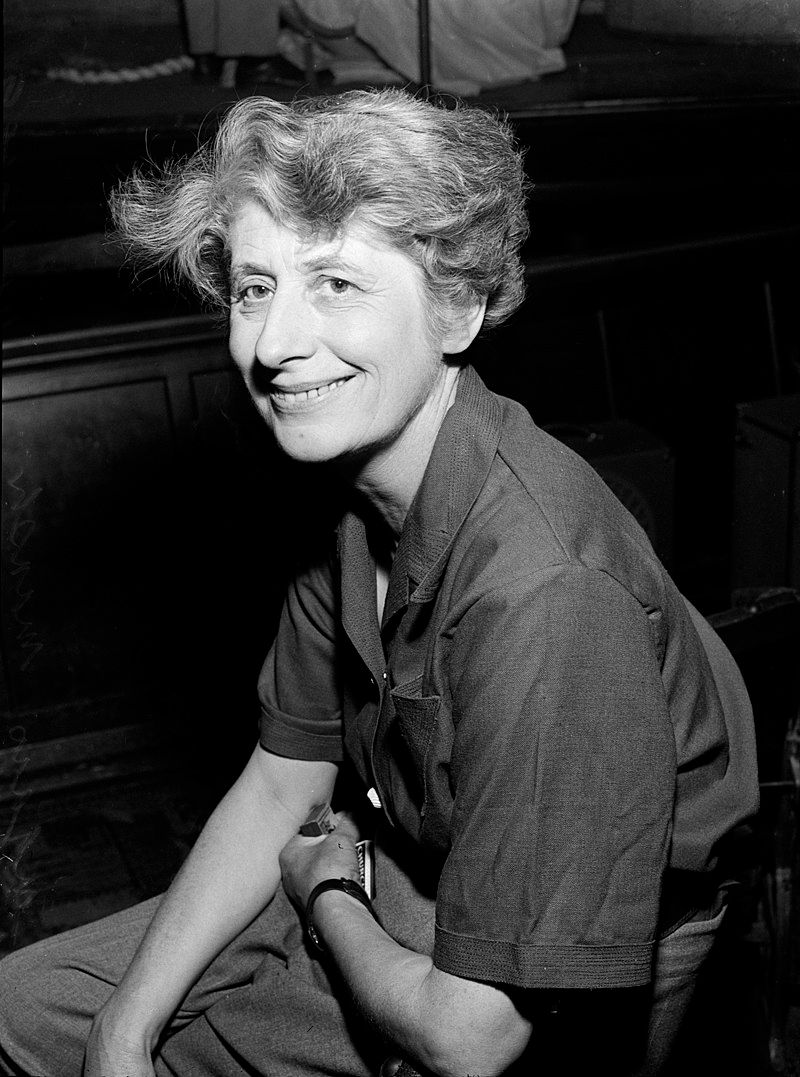
 Ngaio Marsh
 |
In my opinion she's in the running for the best of the lot. Her forte is collecting a large cast of characters with relationships, animosities and ulterior motives. She usually has scenes with rooms filled with people, and the reader must pay close attention to who is saying what to whom in order to have a glimmer of the solution to the crime.
Inspector Alleyn is the police presence in all her mysteries. All but four of the books are set in England. The others are in New Zealand.
Recurring Characters of note:
Inspector (becoming Chief Inspector) Roderick Alleyn
Agatha Troy, his wife
Inspector Fox, his assistant
#1 A Man Lay Dead, 1934
#1 Enter a Murderer, 1935
#1 The Nursing Home Murder, 1935
#1 Death in Ecstasy, 1936
#1 Vintage Murder, 1937
#1 Artists in Crime, 1938
#1 Death in a White Tie, 1938
#1 Overture to Death, 1939
#1 Death at the Bar, 1940
#1 Surfeit of Lampreys/ Death of a Peer (US title), 1941
The Charles Lampreys are a family whose immediate head, Charles, is the younger brother of a peer, George. Consequently, he keeps going through money in the way he's been accustomed to live, but George is the one who inherited the family fortune. Several times, the Charles Lampreys have needed to be bailed out of financial hardship by George. Now George says (apparently), "no more."
The family is a lively bunch, currently living in a double apartment in England (after we first meet them in New Zealand). There are a pair of twins who have spent their lives joking/lying about which is which. The oldest daughter is an actress, and two younger children round out the group. Their favorite passtime is playing charades and they keep a large closet full of props and costumes. Of course there are servants.
George angrily visits after the next request for funds, but he is found in the elevator, seriously wounded by one of the famous props.
This is one of the best examples of Marsh's ability to confuse everything with a huge group of people who are experts at play-acting, and the twins make it even more complex.
#1 Death and the Dancing Footman, 1941
This is a classic Marsh set-up with a lot of characters and confusion.
Jonathan Royal invites a collection of people to his house for a party, purposely choosing guest who have serious reasons to dislike each other. His motive is to create a sort of living drama. The one dis-interested party is his friend Aubrey Mandrake, who writes plays. Jonathan is hoping that Mandrake might find inspiration for a drama in what the guests do and how they interact with each other.
As the reader you immediately know there is going to be a question of mis-identification because there are two identical Tyrolean cloaks, and four people have been known to wear them at various times. Mandrake, while wearing one of the cloaks is pushed into a pool and he cannot swim. He is rescued, but everyone is certain that whoever pushed him thought he was the owner of the cape, Nicholas.
Of course, they get snowed in. Another attempt to harm Nicholas results in him injuring his arm. The finger of guilt points squarely at a naturalized German doctor.
Then... the actual murder takes place. The footman and his antics in the hallway limit the possible suspects, although, as usual, there is so much confused activity it's difficult to sort.
Alleyn is brought over from the town when a car finally manages to get through the drifts to reach him at Chipping, although the roads are still too snowed in to reach Great Chipping where the regular police station is.
#1 Colour Scheme, 1943
#1 Died in the Wool, 1945
#1 Final Curtain, 1947
#1 Swing Brother Swing/ A Wreath for Rivera (US title), 1949
#1 Opening Night, 1951
#1 Spinsters in Jeopardy/ The Bride of Death (US abridged version), 1953
#1 Scales of Justice, 1955
#1 Off With His Head/ Death of a Fool, 1956
#1 Singing in the Shrouds, 1958
#1 False Scent, 1959
#1 Hand in Glove, 1962
#1 Dead Water, 1963
#1 Death at the Dolphin/ Killer Dolphin (US title), 1966
#1 Clutch of Constables, 1968
#1 When in Rome, 1970
#1 Tied Up in Tinsel, 1972
#1 Black As He's Painted, 1974
#1 Last Ditch, 1977
#1 Grave Mistake, 1978
#1 Photo Finish, 1980
#1 Light Thickens, 1982

No comments:
Post a Comment